
DNA Assembly and Patterns
Working on the synthesis post, so how simple is too simple.

Quick fact — about the energy molecule that powers most of your body’s processes: ATP. Every day, your body turns over an amount of ATP roughly equal to your body weight — 100 to 200 lbs or so. Much of it is recycled through the ADP-ATP cycle1, and some is newly synthesized. One of the processes that uses ATP is DNA replication, the focus for today.
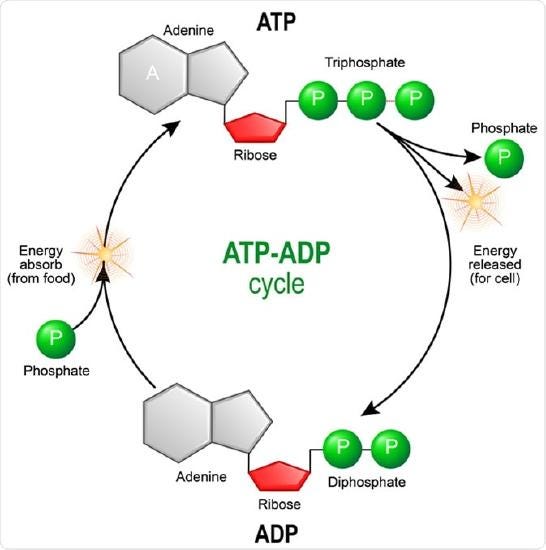
This is just a side note for a post I’ve been working on in the main thread about Synthesis Patterns. Hint: if the topic is patterns and copying, then yes — DNA is going to show up!
In my era of high-school science, the explanation of DNA transcription felt vague, almost automatic — like Velcro that just sticks to everything. That turns out to be a far cry from our current understanding. There are dozens of explainer videos out there now. Two in particular made my top picks, another for fun.
The first is by Cockwork. Its animations are incredibly detailed, and the narrative dives deep into the actual mechanics.
The second video is a bit more schematic — a simplified overview — but still helpful. It’s from Oxford University.
Back to the research notes: if you compare this copying process to something like duplicating a book on a printing press or making a copy of an audio tape, it’s completely different. As both videos describe, it’s more like a factory — a remarkably complex one — with moving parts everywhere.
And speaking of complexity: there are about 100 trillion atoms in a single cell, and around 30 trillion cells in the human body. This video shows one replication. Billions are happening at any time. It’s beyond grasping all the world’s traffic.
OK, one more related video, perhaps the thumbnail tells it all
I'll close with this one last observation. There's something just a bit off about Barney doing biology — or is it VeggieTales? It’s well done, but that smiling ribosome (or maybe it was Helicase starring in another video) feels a little... uncanny. Kinda like the smiling clown in Poltergeist. To be fair, I’ve done aerospace physics lessons for elementary students too, putting concepts on the low shelf, so to speak. — but they got to test the theories with paper airplanes. It was a tangible, hands-on experience, designed to help them understand the things around them. They also could look up and see the real thing flying overhead. Oh, but it is fun, I’m far more likely to remember a smiling ribosome. May you find graciousness in all that you do.
Enough for now - SDG
Introduction to Nutrition Science (Bisson et. al) : 17.1.2: ATP as Fuel for Metabolism